

There are moments when I find myself between what was once familiar and what has not yet taken form. In this space, expectations fill me up as I try to make sense of what has happened, what is coming and how I want to meet the new.
That’s how the coming of spring feels, with its promise of warmth and renewal, yet still carrying the chill of winter. When will spring arrive and who will I become? Who will I have to say goodbye to and who will say hello?
The wider world seems to be holding a similar tension of the unknown. News headlines arrive, with uncertainty and news of suffering, stories still unfolding, outcomes not clear. It is a season of subtle tension, when my world seems to hover between endings and new beginnings.
I’ve noticed a similar rhythm on my yoga mat as I move through surya namaskar, the Sun Salutation, met by a challenge I have a hard time naming. It isn’t always the postures that challenge me, but the transitions – the brief moments when one pose has not yet released and the next has not yet fully arrived. Like when I hover in plank before lowering to my belly, or reach my arms up before standing in tadasana, the Mountain pose.
These in-between moments require a willingness from me to be present and let the new arise, to greet change, even though leaving something behind feels tender.
Resistance to Change: Opening to Possibility
“Even ordinary changes in life are often resisted because of the uncertainty of the unknown. When the unknown is encountered, the intellect, together with the emotions, puts up a struggle to eliminate it or explain it away.” Swami Radha
Resistance arises in moments of transition. Muscles tense up, mind clings to the familiar, the little voice that says “not this!”. Who is it that’s speaking? What part of me resists change and discomfort?
It’s a part of me that’s trying to keep up with the changes around me, holding on to what feels safe and pushing back against the uncertainty of the next moment. And yet, even in that hesitation, there is an opening – a space where curiosity begins to stir.
Swami Radhananda’s words offer some guidance: “In the clearing of the mind, we connect with some inner wisdom and can let go of resistance, which opens us to possibility.”
So, I focus on my breath, close my eyes and acknowledge the hesitancy, inviting the breath to guide me through. As I soften into the exhales, I feel a sense of opening in my mind. Paying attention to my breath helps me accept the in-between and to look forward to the change that’s coming.
Namaste to the Past: Accepting Change with Gratitude
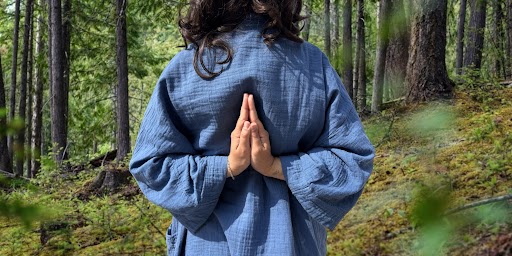
In an attempt to embrace change and transition in what feels to be an ever-changing world, I practice Namaste to the Past, or parsvottanasana. I start in Mountain pose and bring my hands together behind my back. I feel an opening in my shoulders and chest, a sense of bravery and confidence fills me.
I step forward with my right leg and begin to lean forward, in gratitude. My hands remain together behind me – a quiet acknowledgement of where I’ve come from and who I’ve been.
With each breath I am reminded: the past has shaped me, and spring lingers around the corner with the promise of renewal and blossoming. I still cling to the familiarity of the past and feel intimidated by the unknown. There is fear that the new season will bring changes I’m not ready for.
Yet, my feet are steady on the ground, a firm foundation that supports me in the pose. Slowly, I lift my upper body to standing and step my left foot to meet my right, stepping into the new. The transitions in this pose sing like a song: a melody of letting go, a harmony of gratitude and a gentle rhythm of courage.
Foundation and Stability During Life Transitions
This transition shows me that as long as I have a strong foundation, I will be able to step forward and greet what awaits me. But what is the foundation that supports me in times of challenge and change?
Lately, I turn to two powerful anchors: my breath and community. From this place, facing transitions becomes less about resistance and more about acceptance -knowing that change is a natural rhythm of life, not a threat.
Swami Radha offers a helpful reminder:
“You have to learn to accept the good and the bad, just as you do with the weather. Can you change the weather? The weather is a marvelous lesson. You can complain about how cold it is, how rainy it is, how it’s this, that and the other. But you can’t change it. So it’s better that you fit yourself into the weather and take as little notice of it as possible: “Well, it’s raining today. So what? It has to rain. Otherwise nothing grows.””
Following her wisdom, I try to accept the good and the bad, both in the news and in my daily life. I remember that I can’t control what happens in the world, just my part in it. So, I lean into my breath and the support of loved ones as I step toward a new spring, with gratitude for this life.
A Simple Yoga Practice for Navigating Change. Practice parsvottanasana and ask yourself: What is my foundation? How do I greet change in my life now?
-Katie Taher