

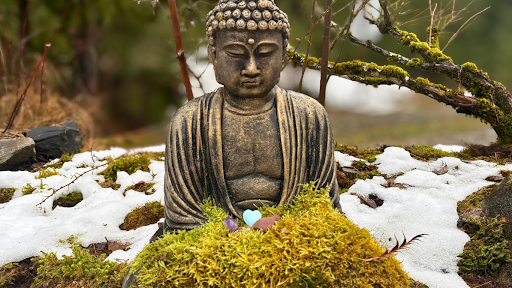
There is the old Buddhist parable about Kisa Gotami, a grieving mother whose only son has died. In her anguish, she asks the Buddha to restore him to life. He instructs her to bring him a single mustard seed from a household untouched by death. As she goes from door to door, she discovers that every family has known loss. Through this realization, Kisa Gotami comes to understand the universality of death and the truth of impermanence, allowing her to accept her grief and find peace.
Her story keeps returning to me whenever I face grief in my own life. I have always loved this parable because it demonstrates our common humanity — our shared suffering of grief and our ability to love deeply.
Recently, in our small community on the East Shore where the Ashram resides, we had two community members whom I was honoured to call friends pass away within a few days of one another. They were well-loved and cherished. Both held the qualities of true compassion, kindness and deep love for their family and community. Their lives touched many people and there now hangs a collective grief in the air as we all find our way through this loss.
These passings, along with other griefs I have experienced, always bring me back to an exploration of love, and to the spiritual teachings on impermanence that help me meet grief with compassion, rather than resistance.
Swami Lalitananda’s words remind me: “Death is a gift that is born with life. In yoga, we don’t ignore the fact, but invite it in to help us live life with awareness.” (The Inner Life of Asanas)
What Does Love Ask of Us in Grief & Loss?
This is a question I am living with deeply right now as I say goodbye to my friends, watch my children find their own paths, and sense that my aging dog will soon no longer be by my side. With my heart broken open, I am often uncomfortably exploring impermanence. I see that it does not diminish love, but instead reveals its depth.
It was in the presence of this love that the Ashram residents gathered to chant Hari Om, a sacred mantra practice, as one of our community friends prepared to move into the Light.
As our voices moved together in devotion, I felt the vastness of love, the place where we are all connected in Divine union. I envisioned our friend flying high above the lake, in instant joy, knowing a love far greater than I could imagine and wrapping Light around everyone.
In that shared devotion, I realized some of what love asks of me in very tangible ways.
Love asks me in grief to open to the Divine, to come together in community and ritual when the weight is too much for one heart to hold. Love asks me to spread the Light to others and witness what radiates back. Reminding me that grief, when held together, becomes something bearable, even meaningful.
It asks me, too, to let go—to allow my children to find their own way. I have to reach deep for this, still seeing myself holding them in my arms, promising I would never let anything bad happen to them. Love is asking me to trust.
Where Love Leads Us in Grief
Love from these griefs is leading me to presence, moment by moment, in everyday life.
I get down on my knees and pet my dog like the goddess she is. I look at my friends and family with a renewed sense of awe and appreciation. I’m putting down what is not important, not quite fully there yet, but like Kisa, learning to put away the mustard seeds.
It is in this unfolding, ordinary devotion that I begin to see Divine Mother’s work in action — the force of compassion and caring that quietly sustains life. Swami Radhananda’s words echo:
“What is Divine Mother’s work? She is the force of compassion and caring, so needed yet so often unrecognized in our world….When you can see Her life-giving rays even in desperate human tragedies, you begin to understand how much there is to learn and how fragile our existence is. It’s important to give wholeheartedly back to life. A different vibration of gratitude is set in motion, a clearer way of looking at the world and the mystery it holds.”
This is what I am still learning to live and to keep asking. And it feels like a question best held in community.
May we come together — in grief, in joy, in the sacredness of the ordinary.
A spiritual practice for coming together in the Light:
–Nicole Plouffe