

At the time of writing this blog, the Ashram’s three-month Yoga Development Course (YDC) has just come to completion. Many of the course participants are transitioning back to families, jobs and environments that are busy with the day-to-day challenges of living in the everyday world.
In the last part of the course, questions were coming up about the transition—”how do I bring all I have gained from my time at the Ashram back into the world—the inner joy, peace of mind, the experience of calm that I’ve had here, and all that’s been revealed about my true nature as old stories and attachments drop away? How do I keep centered as I re-enter a challenging world? How do I convey what I’ve experienced these past three months to my friends and family?”
Having been through the YDC many times myself, both as a participant and as a teacher, I’ve come to understand that it’s a way of being that speaks about the changes that have happened, more than words could ever convey.
Ideas of Love in Spiritual Life
What is this way of being that is often recognized more in others than we can recognize it in ourselves? For me, it is connected to love.
There are so many ideas of what love is in our world, but what is it really?
There is something about ‘it’ that becomes visible and touches my heart when I see it in action—someone responds with kindness instead of reacting with anger…. is patient instead of being irritated….. is calm in situations that are tense…. is listening from a place of wanting to understand instead of having their views or opinions heard.
It is in the moments I see myself responding with kindness, patience or calmness where I would have reacted negatively—that I recognize something else is at work. A release has happened where I’ve been holding on, I’ve become receptive and more present to what is happening. I have a choice of how to respond.
My teacher, Swami Radha, made a distinction between love with attachment and love without attachment—which she called ‘unconditional love’.
“When we have become compassionate, when we can love without expecting anything in return, we have become truly human” (Light and Vibration).
To follow the path of yoga, truly and deeply, involves getting to the root of all that we are attached to. I’ve heard this path described as not for the ‘faint-hearted’. It takes the kind of strength that involves courage—which in the original sense of the Latin cor, means connecting with an inner strength to bring forward heartfelt action.
Ancient Teachings of the Bhagavad Gita
For many years, an ancient text from the East, the Bhagavad Gita, has been part of my life.
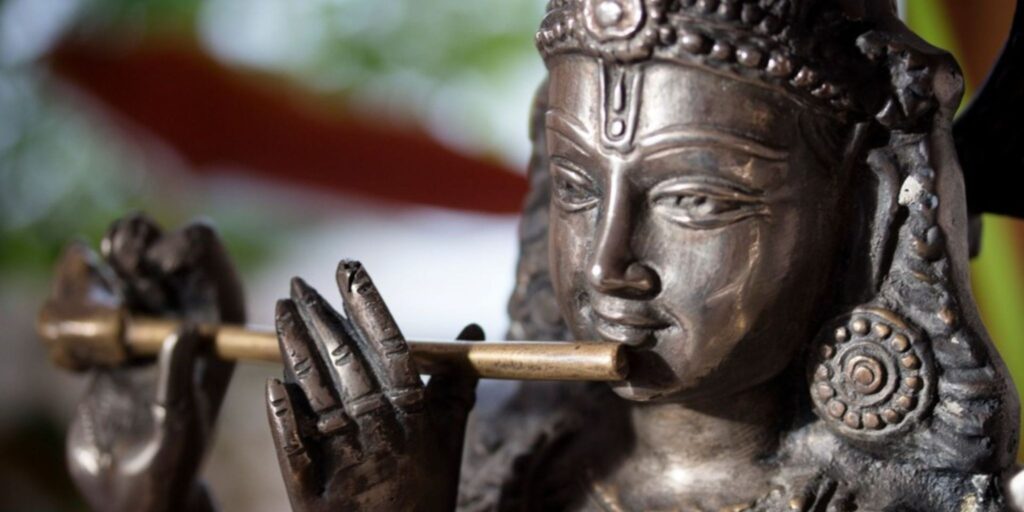
It is a dialogue that takes place in the heart between Krishna, symbolizing the Divine Self, and Arjuna, symbolizing the human self. Its setting is the middle of a battlefield, between opposing forces of dark and light.
Recently, I’ve been bringing some Gita verses to my work each day, from a discourse called “The Way of Love”. The words are a reminder of a way of being that I want to keep cultivating within myself. Krishna says to Arjuna:
“That one I love who is incapable of ill will,
who is friendly and compassionate,
living beyond the reach of ‘I’ and ‘mine’
and of pleasure and pain. Patient, contented, self-controlled,
firm in faith, with all their heart and all their mind given to me
with such as these I am in love” (12:13/14)*.
Our world today is one of opposing forces—which can often become overwhelming and confusing. Like Arjuna, we may sink into despair, asking ourselves: “What can overcome a sorrow that saps all my vitality? Even power over men and gods or the wealth of an empire seem empty.” (2:7/8).
Krishna’s response to Arjuna (in the 18 discourses of the Bhagavad Gita) is as relevant today as it was thousands of years ago when this scripture from the East was first recorded.
“This despair and weakness in a time of crisis are mean and unworthy of you, Arjuna… It does not become you to yield to this weakness. Arise with a brave heart and destroy the enemy.”(2:2/3).
Krishna begins to lead Arjuna on a journey that reveals the real enemy he must destroy is within himself. He calls on Arjuna to remember who he is and that he has the strength within to face whatever he is most attached to in his life—his physical self, his family, friends, possessions, pride, ideas of what is right and wrong—and ways of being that no longer serve him.
Opening the Heart to Light
By bringing the words of sacred texts into my life, through my practices and reflections, they come to life. When I find myself caught in negative emotions, the inner space created by my practices helps me hear another voice—one that is calling me to see what is happening from another perspective.
Being with my teacher, Swami Radha, was an experience that opened my heart to a new perspective and understanding of what love is—one that continues to grow and expand through my commitment to my spiritual path and through the desire to give back to life from a place of love. It has given me a way of being in the world that connects to my Heart.
“The path of the Heart is the path of Light,
the Light of love and the Light of understanding.
Nothing is more important.”
(Light and Vibration, Swami Radha)
*Eknath, Easwaran. The Bhagavad Gita. 2nd ed. Tomales, CA: Nilgiri Press, 2007.
By Swami Satyananda